
The Importance of Brand Identity for Bahraini Startups and SMEs in 2026
Two food startups launched in Manama within three months of each other. Same concept — premium healthy meal boxes delivered across Bahrain. Similar pricing. Comparable product quality based on early customer feedback.
One launched with a coherent brand identity. Considered name, clean visual system, consistent packaging, a clear voice on Instagram, and a website that reflected the premium positioning from the first page. The other launched with a logo made on a free tool, inconsistent packaging, a generic Instagram grid with no visual direction, and a website that looked like a placeholder.
Twelve months later the first business had grown its subscriber base steadily, earned press coverage in a Bahrain lifestyle publication, and was approached by a local supermarket chain about stocking their products. The second had pivoted twice, was still competing entirely on price, and had never managed to charge what their product was actually worth.
The product was not the difference. The brand was.
This is what brand identity does for a Bahraini startup or SME — and this is why treating it as something to get to later is one of the most commercially expensive decisions a founder in this market can make.
What You Will Come Away With
- What brand identity actually consists of — and what it is not
- Why it matters more for startups and SMEs in Bahrain than for established businesses
- The direct commercial consequences of ignoring it in this specific market
- What building it properly looks like at different stages and budgets
Brand Identity vs. No Brand Identity — The Comparison That Settles This
Before anything else, it is worth being honest about what is actually being compared here. The choice is not between a fully developed brand and a basic one. For most Bahraini startups the real comparison is between building a brand identity deliberately and having one emerge by accident — because a brand identity forms whether you design it or not.
Every customer who sees your logo, visits your Instagram, reads your WhatsApp message, or walks into your premises forms an impression. That impression is your brand identity in their mind. The only question is whether you shaped it or whether inconsistency, default settings, and rushed decisions shaped it for you.
| Accidental Brand Identity | Deliberate Brand Identity | |
|---|---|---|
| Visual consistency | Random — changes between touchpoints | Unified across logo, digital, print, packaging |
| Customer first impression | Unclear — could be any type of business | Immediate — communicates who you are and for whom |
| Price tolerance | Low — customers default to negotiating | Higher — perceived value supports the price point |
| Word of mouth | Weak — hard to describe to others | Strong — customers can articulate what you stand for |
| Digital marketing performance | Inconsistent — content has no unifying thread | Stronger — consistent visual and message signals compound |
| Investor or partner perception | Uncertain — looks early-stage regardless of traction | Confident — signals operational maturity |
| Cost to fix later | High — rebrand is expensive and disruptive | Low — built right from the start |
The last row is the one most Bahraini founders underestimate. Rebranding an established business — changing the name, redoing the logo, updating all digital assets, reprinting packaging, rebuilding the website — costs significantly more than building a coherent identity at launch. And it carries an additional cost that money cannot easily fix: the disruption to whatever brand recognition you did accumulate, however imperfect, before the rebrand.
Why Brand Identity Is Not a Logo — What It Actually Consists Of
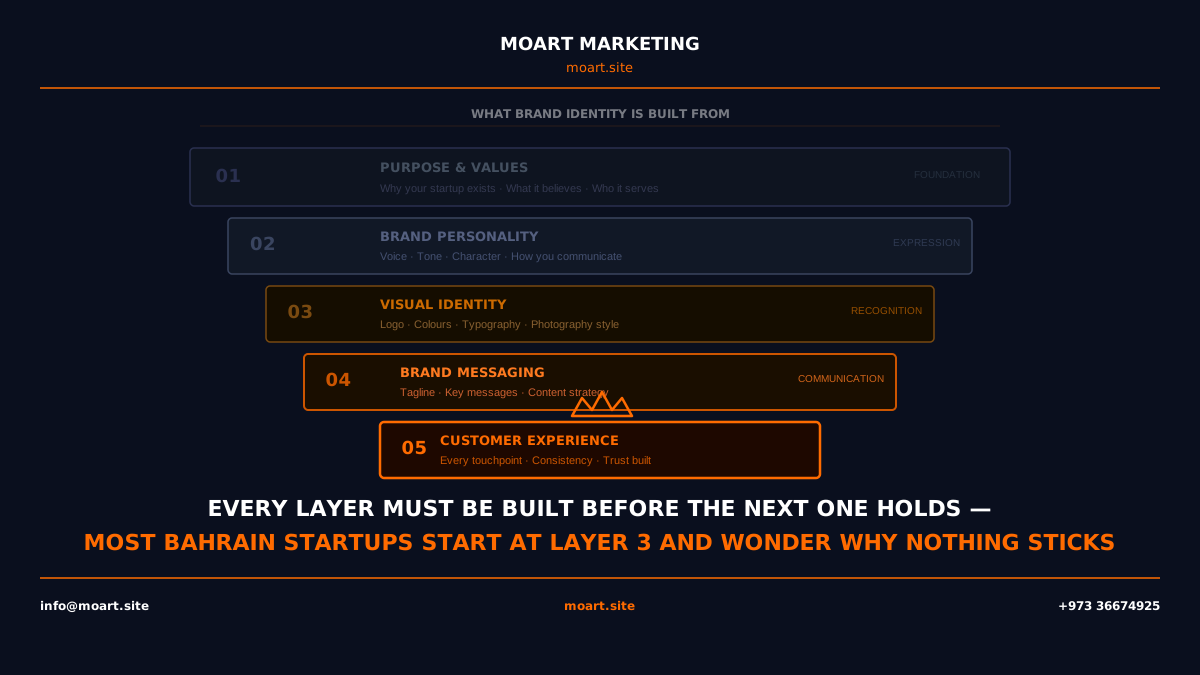
Most Bahraini startups think about brand identity as a visual question — logo, colours, maybe a font. That is layer three of a five-layer system. Starting there without building the layers underneath is why so many Bahrain SMEs end up with branding that looks professional in isolation but feels hollow in practice.
Brand identity starts with purpose — why your business exists beyond making money. For a startup this is usually closely connected to the problem the founder personally experienced or observed. A Bahraini entrepreneur who struggled to find high-quality modest sportswear and built a brand around it has a purpose that is authentic, specific, and instantly communicable to a shared audience.
Personality comes next — the character your brand expresses in every communication. Is it warm and approachable, like a trusted friend giving advice? Sharp and expert, like a specialist you consult for important decisions? Playful and irreverent, like a brand that refuses to take itself too seriously? Personality determines your voice on Instagram, your tone on WhatsApp, the words on your packaging, and the way your team speaks to customers in person.
Visual identity — the logo, colour palette, typography, and photography style — is the layer that makes the personality visible. It is important and it needs to be done well. But a logo that does not reflect a defined personality is just a shape. A colour palette chosen without reference to the audience you are trying to reach is just an aesthetic preference.
Brand messaging is the layer that translates the identity into words — your tagline, your headline on the website, the three sentences you use to describe what you do at a networking event in Seef. Good brand messaging is not clever copywriting. It is clarity. A Bahraini customer who reads your Instagram bio and immediately understands who you are for and what makes you different is experiencing effective brand messaging.
Customer experience is the outermost layer — every touchpoint where the identity meets a real person. The packaging that arrives at a Hamad Town address. The Instagram DM reply that arrives within twenty minutes. The invoice layout. The follow-up WhatsApp message after a first purchase. Each of these is either reinforcing the brand identity or quietly contradicting it.
The Commercial Cost of Weak Brand Identity in the Bahrain Market Specifically
Bahrain’s market has characteristics that make brand identity more commercially urgent than in larger, more anonymous markets.
The network effect here is intense. A professional services startup in Manama that makes a poor first impression on three decision-makers in the same industry has effectively closed a significant portion of its potential client base before the product has been properly tested. In a city where everyone knows everyone, how your brand looks and feels when someone first encounters it carries forward into conversations you are not part of.
The trust threshold is higher in Bahrain than in many comparable markets. Bahraini customers — and especially Bahraini business buyers — rely heavily on recommendation and reputation before engaging with a new supplier or service provider. A brand identity that looks provisional, inconsistent, or generic signals risk. A brand identity that looks considered and coherent signals safety. Customers in this market are often choosing between the business that looks established and the one that looks like it is still figuring itself out. Clear brand identity removes that question.
The digital environment amplifies both sides. An SME in Riffa with a strong, consistent Instagram presence and a well-designed website appears significantly more credible than competitors with twice the operational experience but half the brand coherence. In Bahrain’s social media-driven discovery culture — where restaurant choices, service providers, and product purchases are regularly influenced by Instagram appearances before any other signal — visual brand identity is a commercial filter that customers apply before they ever read a word of your content.
A boutique in Seef with an incoherent visual identity competing for the same customer as a boutique with a clear, premium, consistent brand expression is not competing on equal terms regardless of how good the product is. The customer decision is made before either business gets to demonstrate their product.
The difference between building brand identity as a foundation and treating it as an afterthought shows up exactly here — in the first impression a Bahrain customer forms before they ever interact with the business directly. Moart works with Bahraini startups and SMEs on brand identity as the foundation of every digital strategy they build — because content, SEO, and paid ads all perform better when they are expressing a coherent brand rather than a collection of individual touchpoints with no connecting thread. Visit moart.site to understand what that looks like for a business at your stage.
When to Build Brand Identity — The Staging Question for Bahraini Startups
This is the question most founders ask — at what point does brand identity investment become justified?
The honest answer is: before you acquire your first ten customers. Here is why.
Your first ten customers form the initial community around your brand. They are the people most likely to recommend you, most likely to post about you on Instagram, and most likely to be used as social proof for the next hundred customers. If the brand they encountered and recommended is inconsistent or generic, the word of mouth they generate is similarly undefined. “You should try this place” is weaker than “you should try this place — it is the one with the really clean branding that feels like a proper brand, not just someone’s side project.”
The Bahrain market specifically rewards looking established. A startup in Juffair that launches with the visual coherence and messaging clarity of a two-year-old business acquires credibility faster than one that plans to fix the branding “once things pick up.” Things do not pick up first and then enable the brand investment. The brand investment is part of what enables things to pick up.
What brand identity investment looks like at different stages for a Bahrain SME:
At pre-launch with a limited budget — BD 300–600 for a considered brand identity from a professional designer covers a logo, primary colour palette, typography guide, and basic brand guidelines document. This is enough to launch consistently across digital channels and not look provisional.
At early growth stage — BD 800–1,800 covers a full visual identity system including brand guidelines, social media templates, website design direction, and packaging design if relevant. This is the level at which brand identity starts to actively accelerate acquisition.
At growth and scale stage — BD 2,000–5,000+ covers a comprehensive brand identity including strategy, visual system, messaging framework, tone of voice guide, and full digital asset library. At this level, brand identity is a business asset with measurable commercial value.
These are investment-level figures, not expense-level ones. A Bahrain startup that spends BD 500 on brand identity at launch and acquires ten customers who each recommend two more has a return on that investment that compounds far beyond the initial cost.
According to Meta Business, consistent brand presentation across Facebook and Instagram significantly improves ad performance and organic engagement — what Meta is describing is exactly what brand identity enables at the digital execution layer. Consistent visual and messaging signals compound over time. Inconsistent ones do not.
What Happens When a Bahraini SME Gets Brand Identity Right From Day One
A tech-enabled cleaning service launched in Bahrain targeting expat families and premium residential compounds across Hamad Town, Saar, and Amwaj. Before taking a single booking, the founders invested BD 750 in a professional brand identity — a considered name that communicated reliability and modernity, a clean visual system in a colour palette that felt fresh against the market’s generic competitors, a clear tagline in Arabic and English, and branded WhatsApp templates for all customer communication.
The brand launched on Instagram before the service launched operationally. Forty followers became 200 in the first month purely through organic reach — not paid — because the visual identity was strong enough to be shared. The first ten bookings came through Instagram DMs, almost entirely from people who had seen the brand on someone else’s story.
Within three months they were at capacity and running a waitlist. Within six months a property management company in Amwaj approached them about becoming their exclusive cleaning partner for 40 residential units.
The service quality was good. But their competitors also had good service quality. The brand made them look like the obvious choice before anyone had experienced the service at all.
According to the Bahrain Economic Development Board, the Kingdom’s startup ecosystem is growing rapidly with increasing competition across consumer and B2B sectors. The startups that build brand identity as a foundation from day one are consistently better positioned to attract customers, partnerships, and investment than those that plan to develop it later.
Before launching any digital marketing campaign, it is worth asking honestly whether the brand it will promote is ready to be promoted. An Instagram ad driving traffic to a website that does not reflect a coherent brand identity is wasting budget. A Google ranking driving clicks to a homepage with no clear value proposition is losing customers at the moment of first impression. Moart works with Bahraini startups and SMEs on brand identity before campaigns launch — because marketing built on a strong brand foundation costs less and returns more. WhatsApp +973 36674925 to start that conversation.
FAQ
How much should a startup in Bahrain spend on brand identity?
At a minimum, enough to achieve visual consistency across your primary digital channels — typically BD 300–600 for a professional logo, colour system, and basic guidelines. This is the floor, not the ceiling. The ceiling depends on your sector, your ambition, and how much your target customer’s first impression of your brand will influence their purchasing decision. A B2B professional services startup in Manama targeting corporate clients should invest more than a neighbourhood café — the credibility threshold is higher and the customer relationship begins with a more formal assessment. What is never worth doing is launching with a free tool logo and a generic visual system while planning to “sort the branding later.” Later always costs more and disrupts more than doing it right at the beginning.
Does brand identity really matter for a very small SME in Bahrain, or is it only for bigger businesses?
It matters more for smaller SMEs, not less. A large business with a recognised name and years of customer relationships can carry inconsistent branding for a while because recognition compensates for it. A small SME in Bahrain has no such buffer — every first impression is critical because there is no accumulated reputation to fall back on. The Bahrain market is also social and relationship-driven enough that a small business with a strong, consistent brand identity gets recommended specifically — “go to that place, you will know it by the orange and white packaging” — in a way that a business with no visual coherence never does. Brand identity gives small businesses in Bahrain a competitive surface that operates without any additional marketing spend, every single day.
What is the difference between brand identity and brand image for a Bahraini startup?
Brand identity is what you deliberately build and project — your logo, your visual system, your voice, your messaging. Brand image is what customers actually perceive and remember about you — which may or may not match what you intended. The gap between the two is what brand strategy works to close. For a Bahraini startup, building a strong brand identity is the best available tool for making brand image — what the market actually thinks of you — match the business you intend to build. Without a deliberate identity, the image forms from random signals and the gap between what you are and what you appear to be is impossible to predict or manage. Moart works with Bahrain startups and SMEs specifically on this gap — building identities that project the right signals from the first customer interaction. Visit moart.site or WhatsApp +973 36674925 for a direct conversation about where your brand currently stands.
Bahraini startups and SMEs that invest in brand identity early consistently describe the same shift — they stop having to explain themselves in every conversation and start being recognised before they speak. In a market as compact, social, and relationship-driven as Bahrain, that recognition compounds faster than in any larger Gulf city. The brand becomes a commercial asset that works around the clock — on every Instagram post, every WhatsApp message, every packaging unboxing, every first meeting. If you are ready to build that asset properly from the start, Moart works with Bahraini startups and growing SMEs on brand identity as the foundation of everything that follows. WhatsApp +973 36674925 or visit moart.site.