

Most Bahrain business owners think competitor analysis means checking what their rivals post on Instagram. They spend twenty minutes scrolling through a competitor’s feed, note that they post every day and have more followers, and walk away with no useful information whatsoever.
That is not competitor analysis. That is comparison without intelligence.
Real competitor analysis for digital marketing in Bahrain tells you specifically which keywords your competitors are ranking for that you are not, where their website traffic is coming from, what their Google Business Profile is doing that yours is not, which ads they are running and how long they have been running them, and where the gaps are that your business can step into right now. It turns a vague feeling of “they seem to be doing well online” into a precise map of where to focus your own effort and budget.
This guide walks through exactly how to do it — channel by channel, tool by tool, with Bahrain-specific context throughout.
What You Will Come Away With
- A clear method for identifying your real digital competitors in Bahrain
- How to analyse each marketing channel your competitors use
- The specific tools that work for this market — free and paid
- A repeatable process you can run every quarter
The Biggest Misconception About Competitor Analysis in Bahrain
The assumption most business owners make is that their competitors online are the same businesses they compete with in person. Sometimes that is true. Often it is not.
A restaurant in Seef might assume its online competitors are the other restaurants on the same road. But in Google search, it might actually be losing traffic to a food blog ranking for “best restaurants Seef Bahrain,” a delivery aggregator ranking for “Seef food delivery,” and a competitor three kilometres away whose SEO is strong enough to pull local search traffic far beyond their physical location.
A boutique in Manama might not realise that the business outranking it for “women’s clothing Bahrain” is an online-only store with no physical presence in the country at all — but one with a well-optimised website and strong backlink profile that puts it above every local brick-and-mortar shop for those keywords.
Start any competitor analysis by searching your main keywords on Google — not from your business location, and not while logged into your Google account — and see who actually appears. Those are your digital competitors. Build your analysis around them, not around who you think of as your competition in the physical market.
Step 1 — Map Your Digital Competitors Properly Before Analysing Anything
Open an incognito browser window. Search five to ten keywords your customers would use to find your business — in both Arabic and English. Write down every business that appears in the top five organic results, the Google local 3-pack, and the paid ads section.
Do this for each keyword separately. Some competitors will appear consistently across multiple searches. Those are your primary digital competitors — the ones worth investing analysis time in. Businesses that appear for one keyword but not others are secondary competitors worth noting but not prioritising.
For a clinic in Riffa, this might reveal that the top three local 3-pack positions are owned by one large hospital, one specialist clinic, and a directory website — not another small clinic. That changes the strategy entirely. Instead of trying to compete head-on with a large hospital, the analysis points toward winning the long-tail clinical search terms the hospital’s broad profile does not serve well.
Do this mapping exercise before touching any tool. It takes forty minutes and it defines everything that comes after.
Step 2 — Analyse Their SEO and Google Presence
Once you have your competitor list, start with search — it is where most purchase decisions in Bahrain begin.
What to check on their website:
Look at the page titles and meta descriptions of their main service pages. These tell you exactly which keywords they are prioritising. Right-click any page and select “View Page Source” — search for the title tag near the top. No tool required.
Check how many pages their site has indexed by typing site:competitorwebsite.com into Google. A business with 80 indexed pages has been producing content consistently. A business with 12 pages is thin on content and potentially vulnerable in long-tail search.
Look at their page load speed on mobile using Google PageSpeed Insights — a free tool that takes thirty seconds. If a competitor’s mobile score is below 50 and yours is above 70, that is a genuine ranking advantage you already have and may not know about.
For keyword and traffic data:
Ubersuggest, Semrush, and Ahrefs all offer either free tiers or trial access that provides enough data to see which keywords a competitor ranks for, their estimated monthly organic traffic, and which of their pages drive the most search visits. In the Bahrain market, even modest organic traffic numbers are meaningful because search volume here is lower than in larger markets — a competitor getting 400 organic visits a month from a single well-ranked page is generating real business from it.
Look specifically for keywords where your competitor ranks in positions four through ten. These are terms they are visible for but not dominating — and with focused effort, beatable. In Bahrain’s local search environment, moving from position seven to position two for a high-intent local keyword can be the difference between invisible and fully booked.
Their Google Business Profile:
Search their business name directly and study their GBP. How many reviews do they have? What is the rating? How recent are the reviews — are new ones still coming in monthly or did they stop two years ago? How many photos have they uploaded? Do they post updates regularly?
A competitor with 90 reviews and an average of 4.3 stars, where the last review was eight months ago, has a vulnerability. A structured review acquisition strategy on your end can close and eventually surpass that gap within six months. A competitor with 200 reviews coming in every week is a much harder target on this specific signal — acknowledge it and focus your competitive energy elsewhere.
Step 3 — Audit Their Social Media Without Wasting Time on Vanity Metrics
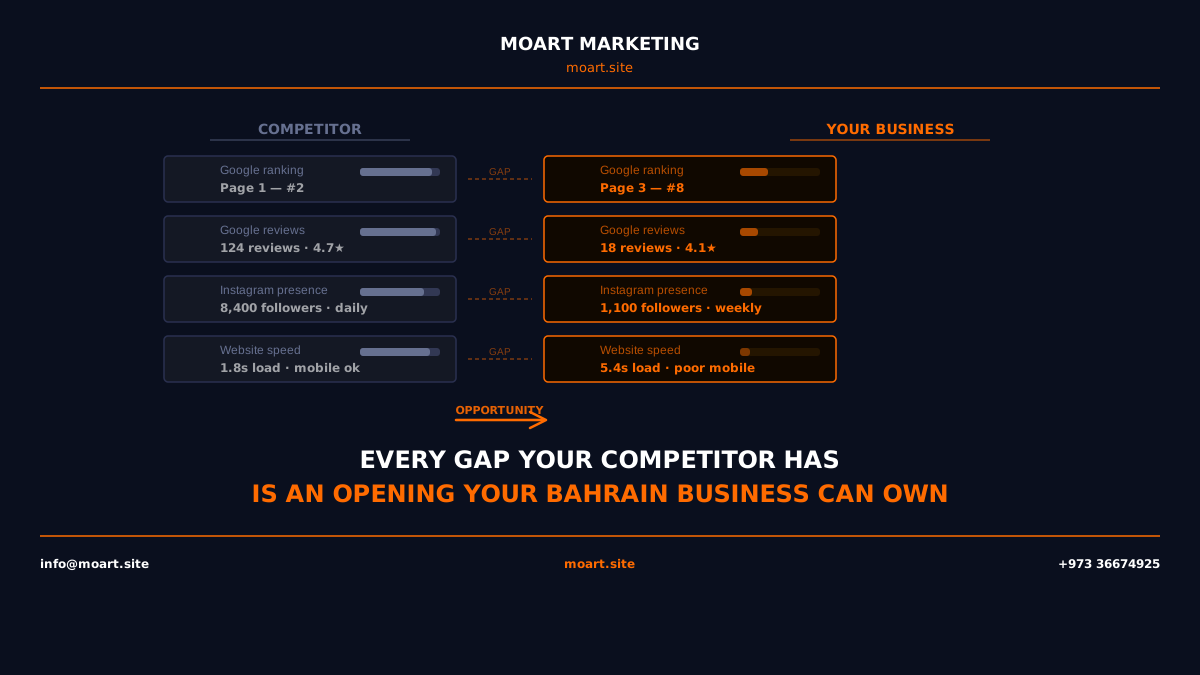
Follower count tells you almost nothing useful. Engagement rate tells you everything.
For each competitor on Instagram, look at their last twenty posts. Count the average number of likes and comments relative to their follower count. A business with 10,000 followers averaging 40 likes per post has a disengaged audience — their content is not resonating. A business with 2,000 followers averaging 180 likes per post has an actively engaged community that trusts and follows them closely. The second business is the more meaningful competitor even though the first looks more impressive.
Look at what type of content gets their highest engagement. Product posts, behind-the-scenes content, customer features, local references, Arabic captions, video versus static. This is not about copying — it is about understanding what the shared audience you are both trying to reach actually responds to in this market.
Check their posting frequency and timing. A competitor posting every day at 7pm in Bahrain is signalling that their analytics show evening engagement is strongest. That is useful market intelligence at no cost.
For TikTok, check their view counts on recent videos rather than follower numbers — TikTok’s algorithm distributes content beyond followers, so views are a more honest measure of content effectiveness. A Bahrain restaurant competitor with consistently high TikTok views on food preparation and kitchen content has found a format that works for their audience. Note it. Decide whether your business can do it better, not just similarly.
The difference between observing competitors casually and building this into a structured quarterly process is significant. Moart builds competitor analysis into every client strategy in Bahrain — tracking the gaps, identifying the openings, and adjusting the plan when the competitive landscape shifts. Visit moart.site if you want that intelligence working for your business rather than against it.
Step 4 — Investigate Their Paid Advertising
Two free tools do most of the work here.
Google Ads Transparency Centre — search any business name and see every active Google ad they are running, what the ad copy says, and how long it has been live. An ad that has been running for four months without being changed is almost certainly performing well — businesses do not keep paying for ads that do not convert. Read the copy carefully. What offer are they leading with? What pain point are they addressing? What call to action are they using? This is tested messaging in your market that you can learn from directly.
Meta Ad Library — go to facebook.com/ads/library, search your competitor’s Facebook page name, and see every active ad they are running on Instagram and Facebook. You can see the creative, the copy, how long the ad has been active, and which formats they are testing. For Bahrain businesses this is particularly valuable because Meta advertising is one of the primary paid channels here for F&B, retail, and consumer services. A competitor running the same ad for three months has found something that works.
Look at both tools quarterly. Competitors who have recently started running ads in a category they were not advertising in previously are either chasing a new market segment or responding to something they have seen working. Either way it is worth noting.
What you are not trying to do is replicate their ads. You are trying to understand what messages are resonating with your shared audience in Bahrain right now — and find the angle or offer they have not thought to use yet.
Step 5 — Build a Simple Competitor Scorecard and Review It Every Quarter
The output of all this analysis should be a simple, usable document — not a complex spreadsheet nobody updates.
For each of your three to five primary digital competitors, record: their top five ranking keywords, their GBP review count and recent rating trend, their social media engagement rate, which paid ads they are actively running, and one gap or weakness you identified. One page per competitor. Update it once a quarter.
The pattern that emerges across multiple competitors is more useful than any single data point. If three of your five competitors have weak mobile website scores, that is a market-wide gap — and fixing yours puts you ahead of all of them simultaneously. If none of your competitors are producing Arabic content on Instagram despite a heavily Arabic-speaking local audience, that is an uncontested space you can own quickly.
According to Google Search Central, understanding how search works and how your competitors have positioned themselves in search results is one of the most direct ways to improve your own organic visibility — the intelligence is freely available for anyone willing to gather it systematically.
A Real Bahrain Scenario — What Competitor Analysis Uncovered

A real estate company in Manama was spending BD 500/month on Google Ads and getting inconsistent results. When a proper competitor analysis was run, three things became clear.
One competitor was ranking organically for the six highest-intent Bahrain property search terms without running any ads at all — their content library was producing traffic that the real estate company was paying to buy. A second competitor had 143 Google reviews with an average of 4.8 stars and was appearing in the local 3-pack for every relevant area search in Manama and Seef. The real estate company had 11 reviews.
The analysis did not just show what the competitors were doing well. It showed exactly where to focus — build content for the six organic keywords being dominated, launch a review acquisition process to close the GBP gap, and reduce ad spend on terms where organic was a more cost-effective path.
Within five months, organic traffic had reduced the required ad spend by 35%. The strategy was not new creativity. It was intelligence applied correctly.
According to the Bahrain Economic Development Board, digital commerce and online business participation among Bahraini SMEs is growing year on year. That means more competitors entering digital channels every quarter — which makes regular competitor analysis not a one-time exercise but a permanent part of how smart Bahrain businesses stay ahead.
Before you build your next marketing plan, getting a professional competitor analysis done for your specific sector and location in Bahrain gives you a foundation that no amount of general advice can replace. Moart runs exactly this kind of analysis for Bahrain businesses — mapping who is winning in your market, why, and where the gaps are that your business can step into. WhatsApp +973 36674925 to start that conversation.
FAQ
How often should a Bahrain business run a competitor analysis for digital marketing?
Quarterly is the right cadence for most small to mid-sized Bahrain businesses. The digital landscape here moves fast enough that a competitor can go from no SEO presence to outranking you in six months if they invest properly. A quick monthly check on their Google Business Profile review count and social media activity supplements the deeper quarterly audit. Businesses in highly competitive sectors — F&B, property, healthcare — benefit from monthly tracking of at least the paid ads and GBP signals, since these change frequently and signal shifts in competitor strategy quickly.
What free tools can a Bahrain business use for competitor analysis without a big budget?
Google’s own ecosystem covers most of the basics at no cost. Google Search in incognito mode for keyword mapping, Google PageSpeed Insights for technical comparison, Google Ads Transparency Centre for paid ad intelligence, and Meta Ad Library for social advertising. For SEO data, Ubersuggest’s free tier provides basic keyword rankings and traffic estimates. Google Business Profile search shows competitor review count, rating, and activity level. A business owner who dedicates three hours quarterly to working through these tools systematically will have more actionable intelligence than most of their competitors in the Bahrain market.
What is the most important thing to look for in a competitor analysis for a Bahrain business?
Gaps — specifically gaps in areas where customer decisions are made. A competitor with weak reviews despite strong search rankings is vulnerable to being overtaken by a business that invests in review acquisition. A competitor ranking well on Google but completely absent on Instagram is missing a portion of the Bahrain audience that makes decisions socially. A competitor with strong social presence but a slow, poorly optimised website is losing customers at the moment of conversion. Find the gap that sits between where your competitor is strong and where your shared customers actually make their decision — that is where your effort produces the fastest measurable return.
Bahrain businesses that run competitor analysis properly — systematically, quarterly, tied to specific actions — consistently say the same thing: they stopped guessing about where to focus and started seeing exactly where their effort would pay off. The intelligence is there. Your competitors are generating it every day through the decisions they make online. The only question is whether you are collecting it and using it. If you want a professional competitor analysis done for your business in Bahrain — mapped to your sector, your location, and your specific growth goals — Moart is the practical next step. WhatsApp +973 36674925 or visit moart.site.